
Senate Inquiry Says Take Triple Zero Out of Telstra's Hands
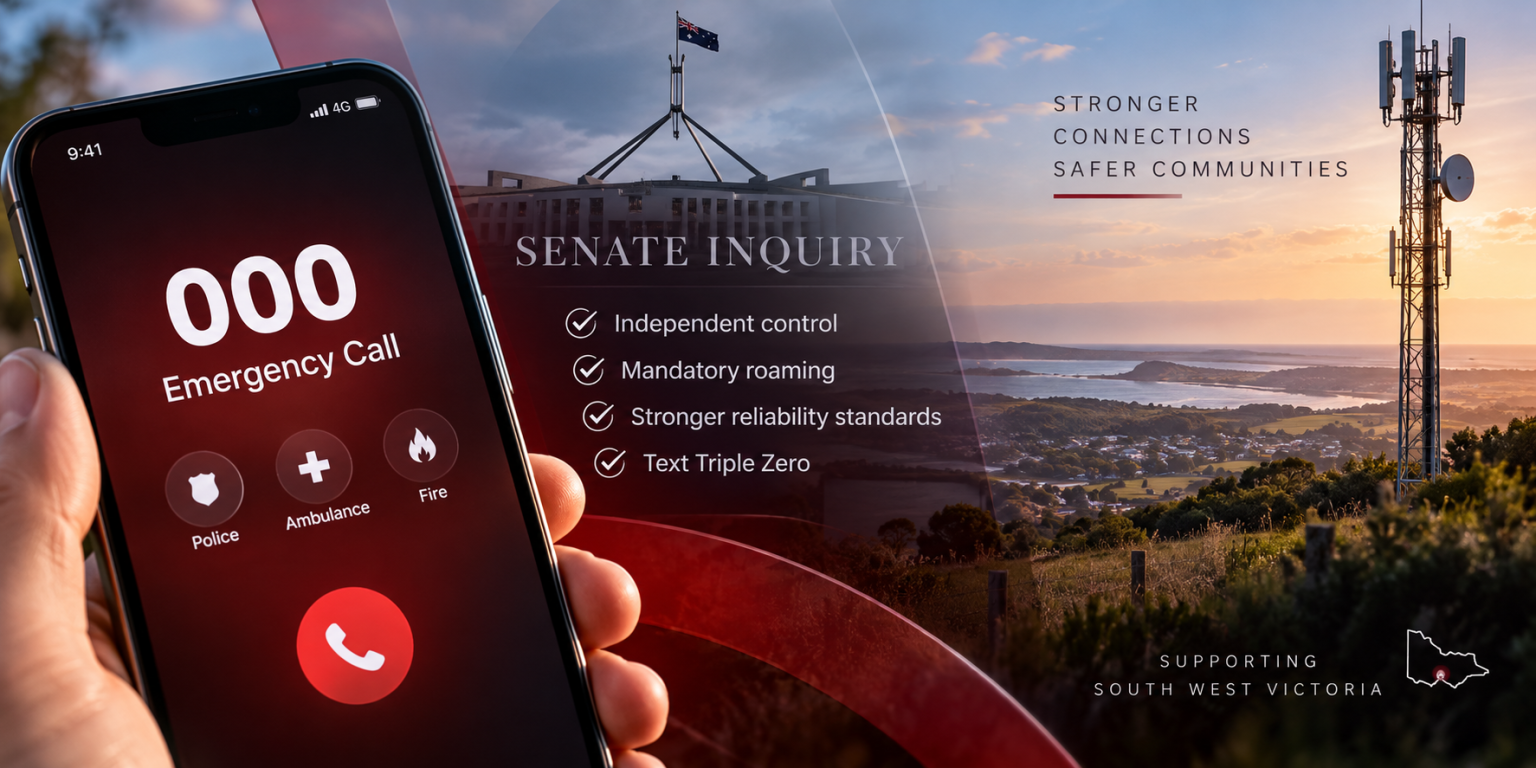
Triple Zero reliability is back under the spotlight, with a Senate inquiry recommending major changes to the way Australia's emergency call system is managed — including independent control, domestic mobile roaming and tougher reliability standards.
South West Victoria hasn't had major network or tower news of its own this month — no new blackspot funding or significant 5G upgrade announcements for Warrnambool, Portland, Colac, Hamilton or Camperdown since our last update. But nationally, the conversation around Triple Zero (000) reliability has moved quickly.
A long-running Senate inquiry has now handed down its final report, calling for substantial changes to Australia's emergency calling system. Some of the recommendations could be particularly important for people and businesses in regional areas where mobile coverage can still depend heavily on one network or one nearby tower.
Senate inquiry: take Triple Zero out of Telstra's hands
A Senate committee released its final report on 21 September into Australia's ongoing Triple Zero emergency call issues, making 11 recommendations aimed at strengthening the system.
The inquiry began following the major Optus outage in September 2025 and was later expanded as further emergency calling failures affected both Optus and Telstra networks.
Committee chair Senator Sarah Hanson-Young said removing Telstra's control of the system should be at the top of the government's agenda.
What else has the Senate recommended?
Stronger reliability standards
Minimum performance and reliability standards for telecommunications providers, along with automatic compensation for customers affected by qualifying outages rather than relying solely on case-by-case claims.
Mandatory domestic roaming
Phones could connect through another carrier's network when their own provider is unavailable during an emergency — potentially a significant improvement for regional and coverage-patchy locations.
Texting Triple Zero
The committee has recommended developing the ability for people to contact Triple Zero by text during an emergency.
Review of ACMA's role
The report also recommends reviewing the role of the Australian Communications and Media Authority in overseeing and regulating the Triple Zero system.
Fresh figures from the September Optus outage
The report follows another serious emergency-calling incident involving Optus. Updated figures relating to the 12 September outage show a 76-minute fault affected customers across Victoria, South Australia, Tasmania and the Northern Territory.
Victoria Police subsequently carried out 41 welfare checks, Tasmania Police carried out three and South Australia Police followed up another two calls. Authorities reported that no further assistance was ultimately required in those cases.
Compensation and tougher penalties are already changing
Penalties available for serious telecommunications breaches have already been significantly increased, with maximum penalties reaching up to $30 million in some circumstances.
From 1 November, carriers will also face stronger requirements to provide real-time outage information to emergency services, government and the regulator rather than relying on information being supplied after an event.
A Carriage Service Provider registration scheme is also being introduced, giving regulators better visibility of the telecommunications providers operating across Australia.
Compensation is another area receiving attention. Telstra has said it paid close to $1 million in credits to approximately 33,000 customers following its July outage. Optus has not publicly detailed customer compensation from its outages, citing customer confidentiality.
What does this mean for South West Victoria?
None of these recommendations changes mobile coverage overnight. But some could have real significance for regional communities.
In parts of Western Victoria, customers can still find that one carrier has coverage while another has little or none. If a tower or part of a carrier's network goes offline, there may currently be another perfectly usable mobile network nearby that the customer's phone cannot normally access.
Mandatory domestic roaming could change that. During an emergency, a phone could potentially use another available carrier network rather than being completely dependent on the customer's normal provider.
Combined with stronger minimum reliability standards, better outage reporting and tighter oversight of Triple Zero, that could provide additional resilience for regional communities where communications during an emergency can be particularly important.
What happens next?
The Senate committee has made its recommendations, but that does not mean each proposal automatically becomes law or government policy.
The Federal Government is expected to formally respond to the committee's report in the coming months. That response should give a clearer indication of which recommendations — including mandatory domestic roaming and changes to the management of Triple Zero — will progress.
Checking an outage?
For current network information, check directly with your mobile or internet provider.
For information about Australia's national emergency warning system, visit ausalert.gov.au.
Sources & further reading
- ABC News — Triple Zero should be taken out of hands of major telcos, Senate inquiry recommends
- Capital Brief — Senate committee calls for nationalisation of Telstra-operated Triple Zero infrastructure
- Australian Greens — Triple Zero inquiry recommendations
- Information Age — Another Optus mobile outage blocks 46 Triple Zero calls
- Sparke Helmore — Triple Zero outages, enforcement action and additional telco regulation
- WTCO — South West Victoria's Mobile Network Is Getting a Major Upgrade
Struggling with Poor Communication Systems?

Claim Your FREE 30-Minute Business Communications Strategy Session
(Valued at $880)!
Discover how to boost productivity and get great value—without the sales jargon or years of trial and error. Limited spots available!