
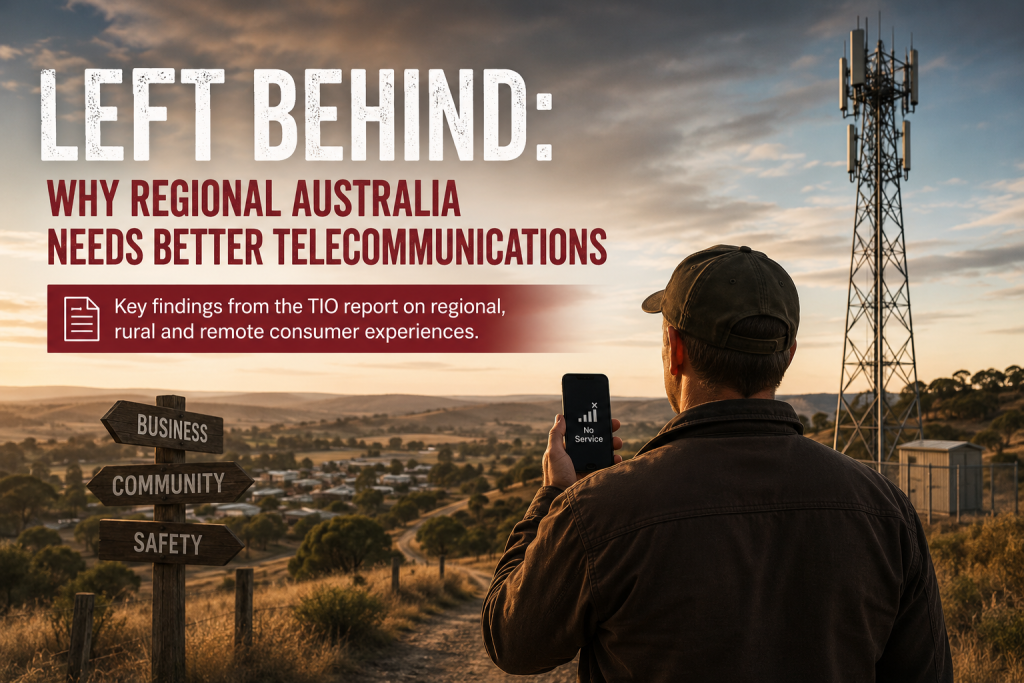
Left Behind: Why Regional Australia Needs Better Telecommunications
A new Telecommunications Industry Ombudsman report highlights the very real challenges facing regional, rural and remote Australians when phone and internet services fail.
Reliable telecommunications are no longer optional.
Our phones, internet connections and mobile networks connect businesses to customers, EFTPOS terminals to banks, staff to each other and communities to essential services.
But according to the Telecommunications Industry Ombudsman's report, Left Behind: Experiences of telco consumers living in regional, rural and remote Australia, where you live can still have a significant impact on the telecommunications services available to you.
complaints from regional, rural and remote Australians were analysed across the 2024–25 and 2025–26 financial years.
Four major problems facing regional Australia
The TIO identified four recurring issues affecting people and businesses outside Australia's major cities.
1. Getting telecommunications problems fixed can take longer
A telecommunications fault that might be frustrating in Melbourne can become a much bigger problem in a regional town or on a rural property.
Consumers told the Ombudsman about waiting weeks or even months for technicians, appointments being repeatedly cancelled or rescheduled, and faults returning after temporary repairs.
There are simply fewer alternatives when the nearest technician, retail store or replacement service may be hours away.
2. Mobile coverage remains a major issue
More than 2,300 regional, rural and remote consumers contacted the TIO over the two-year period about mobile services that were unreliable, unavailable where they needed them, or had deteriorated.
Coverage can also vary depending on terrain, building construction, network congestion and the exact location of a business or property.
A coverage map can tell you what should be available. It does not necessarily tell you what actually works inside your office, workshop, warehouse, farm shed or home.
3. Regional customers often have fewer choices
One of the most important findings is that regional consumers can have considerably fewer practical alternatives when a service does not work.
Depending on location, there may only be one viable mobile network, one practical internet technology or a limited number of providers able to deliver the required service.
Satellite services have expanded the options available in many locations, but they are not automatically the right answer for every property or business.
Cost, equipment, power, latency, coverage and the requirements of other business systems all need to be considered.
4. When communications fail, regional businesses feel it
This is perhaps the most important part of the report for regional businesses.
The TIO documented businesses unable to process EFTPOS transactions, place orders with suppliers, receive important customer calls or reliably communicate because telecommunications services were not working.
Unable to process payments when connectivity fails.
Missed enquiries and potential lost sales.
Difficulty ordering stock and coordinating deliveries.
Cloud systems, monitoring and remote equipment can stop working.
For a business, that's not simply poor internet.
That's lost productivity, lost sales and potentially lost customers.
What happens when the power goes out?
The report also raises an important issue for businesses and residents outside metropolitan areas — modern telecommunications increasingly depend on local power.
NBN equipment, Wi-Fi networks, cordless phones, cloud phone systems, mobile boosters and satellite equipment generally require electricity at the premises.
For businesses where communications are critical, backup connectivity and backup power should now be part of the conversation.
Having two telecommunications services is not much of a backup strategy if both stop working because they rely on the same power source or underlying infrastructure.
The Ombudsman wants significant changes
The TIO is not simply highlighting the problem.
The report calls for broader changes to Australia's telecommunications framework, including better regional access to technicians, clearer remedies when repairs are significantly delayed, improved consumer education and better information about which telecommunications technologies are actually available at a location.
It also recommends stronger minimum service standards for certain broadband services, including connection, repair and appointment timeframes.
These are significant recommendations because telecommunications are now essential infrastructure for businesses and communities.
What does this mean for Western Victoria?
At WTCO, there is one part of this report that particularly resonates with us:
There isn't one connection that is right for every business.
A business in Warrnambool can have completely different requirements from a farm outside Hamilton, a workshop in Portland, a retailer in Colac or a business operating across several regional locations.
That's why we believe the conversation should start with the business — not the plan.
Questions every regional business should be asking
- What NBN technology is available at our address?
- Which mobile networks actually work at the site?
- Where is the NBN equipment installed?
- Is our internal Wi-Fi giving us the coverage and performance we need?
- What happens to our phone system if the internet fails?
- Do we need a backup connection?
- Which business-critical systems rely on connectivity?
- Who do we call when something stops working?
This is why we offer Communications Audits
WTCO's onsite Communications Audits allow us to look at the complete environment rather than one service in isolation.
We can review your NBN connection, business phone system, mobile coverage, Wi-Fi, networking equipment, cabling and potential backup options, then explain what is working, what could be improved and where the risks are.
Sometimes the existing setup is perfectly adequate.
Sometimes a relatively small change can make a significant difference.
The important part is having someone actually look at it.
Is your communications setup actually right for your business?
Talk to WTCO about a Communications Audit and get practical advice on your NBN, phones, Wi-Fi, mobile coverage and backup options.
Communications Audit Call 1300 765 985Regional shouldn't mean second-rate
The TIO's Left Behind report puts national data behind something regional Australians have been saying for years.
Where you live shouldn't determine whether you can reliably run your business, contact your customers or access important services.
There is still plenty of work for Australia's telecommunications industry to do.
In the meantime, regional businesses can make sure the services and technology already available to them are being used properly — and that they have a plan for when something doesn't work.
Read the TIO report
Struggling with Poor Communication Systems?

Claim Your FREE 30-Minute Business Communications Strategy Session
(Valued at $880)!
Discover how to boost productivity and get great value—without the sales jargon or years of trial and error. Limited spots available!