
Emergency Communications
National Emergency Alert Test: Why Some Phones Missed the Message
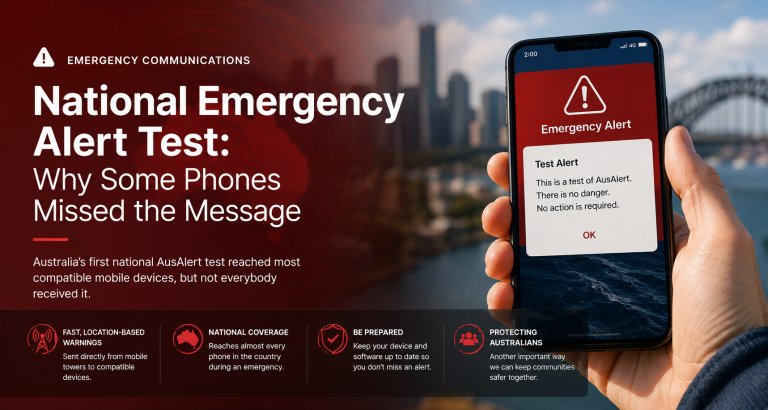
Australia’s first national AusAlert test reached most compatible mobile devices, but not everybody received it.
On Monday 27 July 2026, the Australian Government conducted the first national test of AusAlert, Australia’s new emergency warning system.
At approximately 2:00 pm AEST, a test Critical Alert was broadcast to compatible mobile phones, tablets and smartwatches across the country. Devices that received it displayed a test message, vibrated and played a siren-like warning sound for around 10 seconds.
AusAlert is intended to provide fast, location-based warnings during emergencies such as bushfires, floods, cyclones, severe storms, public health incidents and security threats.
It uses Cell Broadcast technology, allowing an alert to be sent from mobile towers directly to compatible devices within an affected area.
How did the test go?
By the government’s main technical measure, the test was successful. Approximately 94% of Australia’s mobile towers successfully broadcast the alert, exceeding the National Emergency Management Agency’s target of 90%.
Missing the test alert does not necessarily mean there is something wrong with your mobile service. Device compatibility, software versions, mobile coverage and tower availability can all affect whether an alert is received.
While the tower broadcast rate was strong, plenty of Australians reported receiving no notification, receiving the message without the expected sound, or seeing it appear differently from nearby phones.
Why some phones didn’t receive it
AusAlert depends on both the mobile network and the receiving device supporting the required Cell Broadcast standards. A newer phone may still miss an alert when its operating system has not been updated.
AusAlert is expected to work on:
- Apple iPhone 11 and newer running the required version of iOS.
- Compatible Apple Watch models running the required version of watchOS.
- Android phones and tablets running Android 12 or later.
Some older devices may still receive alerts, but their behaviour and the way the message is displayed can vary.
Other reasons a device may have missed the national test include:
- The phone was switched off or in aeroplane mode.
- The phone was not connected to a mobile tower when the alert was broadcast.
- The phone’s operating system was not up to date.
- The device was in an area with limited or no mobile coverage.
- The nearest mobile tower was offline, undergoing maintenance or experiencing an outage.
- The device or operating system does not fully support AusAlert.
What should you do?
1. Update your software
Install the latest operating-system updates and restart your phone afterwards. This may enable emergency-alert support on compatible hardware.
2. Check compatibility
Check your exact phone model and required software version against the official AusAlert compatibility information.
3. Don’t rely on one channel
During an emergency, continue checking official emergency apps, websites, local radio and instructions from emergency services.
The bigger picture
The national test was designed to identify these kinds of differences between mobile towers, networks, software versions and devices before AusAlert becomes fully operational.
AusAlert is expected to launch nationally in October 2026. The system will become another important emergency communication channel, but it will not replace the need for official emergency apps, radio broadcasts, websites, television updates and advice from local authorities.
No emergency warning method can reach every person in every location every time. However, Cell Broadcast gives emergency authorities a faster way to warn large numbers of people without sending millions of individual text messages.
Is your mobile device ready?
Keeping your mobile phone updated is important for security, reliability and access to new services such as AusAlert. WTCO can help businesses review mobile devices, mobile coverage and business communication services.
Call WTCO on 1300 765 985Struggling with Poor Communication Systems?

Claim Your FREE 30-Minute Business Communications Strategy Session
(Valued at $880)!
Discover how to boost productivity and get great value—without the sales jargon or years of trial and error. Limited spots available!